US6152043A: Portable tracked wheel
A portable tracked wheel allows the operator or robot to move a vehicle from a surface track to another, or free the vehicle from guided motion without disassembly or modification of the wheel or track. By depressing the lock tab manually with hand or foot or remotely by mechanical or robotic means, the track retention mechanism can be positively engaged and the motion of the vehicle disposed to the track. Disengagement from the track is accomplished by depressing the lock tab in the same manner, allowing the retention mechanism to rotate out of the track, thereby freeing the motion of the vehicle. The anti-lift tracking mechanism is spring-loaded to maintain constant adhering force between the wheel and the tracked surface. Lateral translation of the wheel on the track is precluded by a slanted contact interface between the device and the track.

US6905298B1: Telescopic nut
A nut assembly is disclosed that will ensure that the shank of a bolt that features a measurable grip length will pass through the contact plane of adjoining members. The nut assembly also allows the desired compressive force in the adjoining members to be attained by using a telescopic feature of the nut to allocate additional thread action for the bolt, enabling the bolt to be drawn into the nut further than what would be allowed by a standard nut. The adaptability of the nut assembly can eliminate the need for washers or shims to adjust the shank penetration of the bolt. The nut assembly is useful for application in which the specified thread length and the grip length of the bolt is incompatable with the abutment thickness of the adjoining members.
US6532038B1: Rail crossing video recorder and automated gate inspection
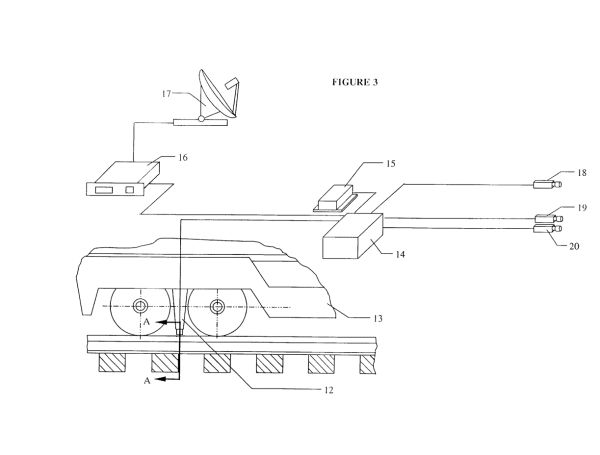
An invention is presented that expedites cause, fault and liability litigation of rail-highway crossing mishaps by providing a digital audio and video record of the events at the crossing as the locomotive or rail vehicle approaches and passes through the intersection. The electrical system components are located on and within the locomotive and can be powered exclusively by resources available from the locomotive. In addition, the invention may automatically and spontaneously inspect the operational status of the rail-highway crossing gate by capturing and processing the digital images of the gate by computational methods programmed in the locomotive's on-board computer. Alternatively, the images or video could be transmitted to a remote station for processing or inspection. If it is determined that the gate is malfunctioning, the computer may tag the digital image with relevant information from positioning equipment such as a Global Positioning Satellite (GPS) and may transmit the identified image via satellite or other communications network to the command station for further review. Since the locomotive can power the electrical components of the system, simple mechanical interrupt devices may be used to activate and deactivate the system. This system is effectively secure from sabotage, vandalism and environmental deterioration.
GLACIER Crystal Growth Support
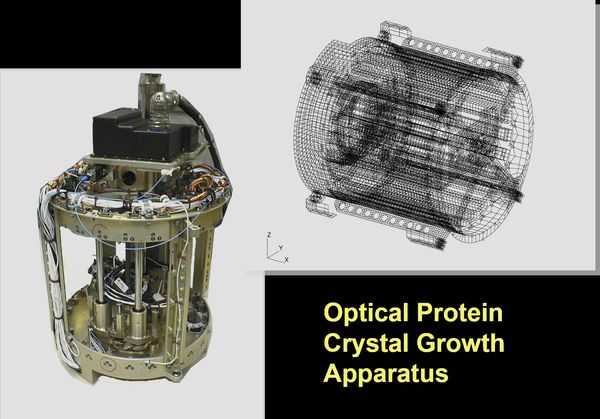
GLACIER is an active cryogenic freezer/refrigerator system used on the International Space Station, and UAB's Engineering and Innovative Technology Development (EITD) group originally designed and developed it to support space-based biological sample storage and protein crystal growth experiments